
How To Completely Remove Docker From Your Debian Based Linux

This is a simple note to myself of how to remove Docker from Ubuntu or Raspberry Pi OS (previously called Raspbian). Credit goes to Mayur Bhandare on Stack Exchange. I also added some explanation to some of the commands so you will have a better understanding of what they’re doing.

1. Identify which Docker package have you installed
dpkg -l | grep -i docker

For example, I’ve installed docker-ce and docker-ce-cli

The dpkg command is a package management command in Debian. Just like apt-get in Ubuntu, a Linux distro based on Debian. Since Raspberry Pi OS is also a descendant of Debian, this will work just fine. The above command is basically saying, give me a list of packages that contains the word “docker” in them.

2. Remove the packages

For me, I’ve only installed docker-ce and docker-ce-cli. So I will run the following commands.

sudo apt-get purge -y docker-ce docker-ce-cli
sudo apt-get autoremove -y --purge docker-ce docker-ce-cli

If you have more docker packages installed, you can add those packages names to the end of the commands above. For example:

sudo apt-get purge -y docker-engine docker docker.io docker-ce docker-ce-cli
sudo apt-get autoremove -y --purge docker-engine docker docker.io docker-ce 

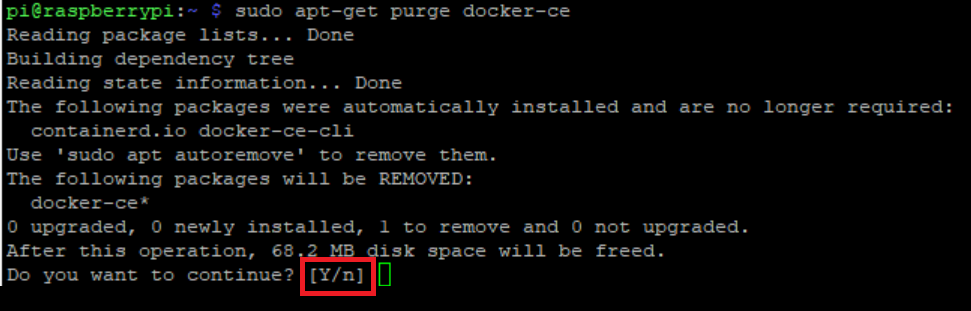
The “-y” flag here is to answer “yes” to the command prompt when it asks you whether to remove a package. You can choose to remove the “-y” flag. Then you’ll see prompts like the following and you have to manually answer yes or y for every package.
3. Remove all the Docker related files

After that, you might want to remove all the Docker images, containers, volumes, and configurations. This is how:

sudo rm -rf /var/lib/docker /etc/docker
sudo rm /etc/apparmor.d/docker
sudo groupdel docker
sudo rm -rf /var/run/docker.sock

The “-rf ” flag is a combination of the “-r” and “-f” flags. “-r” means recursive. So the rm command can remove all the children folders and files of the target folder recursively. “-f” means force. It will ignore non-existent files, and never prompt before removing them. Be careful when you use these two flags together.

The groupdel command is to delete an existing docker user group.

Bonus: Deactivate Network Interface and Ethernet Bridge

If you want to take one step further, you can deactivate the docker0 network interface and delete the docker0 ethernet bridge. Here’s how(Credit: Thanks to anony for mentioning that!😁):

To disable docker0 network interface:

sudo ifconfig docker0 down

To delete the existing docker0 ethernet bridge:

sudo ip link delete docker0

The brctl command is deprecated. Updated the above command. Credit to Nicolas Raoul and Søren (Edited on 2024-03-26)

Congratulations! You have just completely removed Docker from your system!

If my note helped, please consider buying me a coffee😁.

Cheers,
Lok

Comments

25 responses to “How To Completely Remove Docker From Your Debian Based Linux”

  1. dietrich Avatar
    dietrich

    Great, thanks! Had a lot of trouble with it, kernel not matching with cgroup etc. and all the tipps online i could get were nonsens.
    with your help my system is clean after my first errors with docker. Not mentioned: clean the sources.list!

    1. Lok C Avatar
      Lok C

      I’m glad that it helps 😄

  2. cotchon Avatar
    cotchon

    Thank you for the straight forward Docker removing method !!

    1. Lok C Avatar
      Lok C

      No problem! Glad that it helps!

  3. Tim C. Avatar
    Tim C.

    When I entered /var/run to remove docker.sock I noticed there’s a docker directory as well ‘/var/run/docker’. Forgive this noob, but should that be removed too?

    1. Lok C Avatar
      Lok C

      Yes, you can remove it with the following command:
      sudo rm -rf /var/run/docker.sock

      This command is the 4th line in the 3rd step. I hope it helps😊

      1. Chris Avatar
        Chris

        What about the directory `/var/run/docker`? Should that be removed, too?

        1. Lok C Avatar
          Lok C

          Yes. You can do that in step 3.

  4. anony Avatar
    anony

    You may want to run these two commands as well at the end:

    # ifconfig docker0 down

    # brctl delbr docker0

    1. Lok C Avatar
      Lok C

      Thanks for the info! I’ve added a bonus step to the blog post😁.

  5. Bernie Dahlstrom Avatar

    This was the clearest and cleanest page of instructions I have ever used.
    Many thanks to Lok C and all the individules given credit herein.

    Great job — Bernie

    1. Lok C Avatar
      Lok C

      I’m glad that it helps😁

  6. Nicolas Raoul Avatar

    About the section “Deactivate Network Interface and Ethernet Bridge”:

    1. You must prefix each command with sudo
    2. The commands use `docker0` but the explanation read like “dockero”, which can be confusing. Maybe change the font or put `docker0` in inline source form.
    3. brctl has been deprecated and does not exist anymore on most distributions. I successfully used this command instead: ip link delete docker0

    Thanks!

    1. Lok C Avatar
      Lok C

      Thanks for the suggestion! I’ve updated the post accordingly.

  7. Søren Avatar

    I didn’t have `brctl` but `sudo ip link delete docker0` did the trick for me. Thank you for posting this!

    1. Lok C Avatar
      Lok C

      Thanks for the suggestion! I’ve updated the post.

  8. Albert Avatar
    Albert

    The docker-user still exists on my system after using your instructions.
    Also in the file /etc/subuid there is a reference to the docker-user.

    1. Lok C Avatar
      Lok C

      /etc/subuid is used for user namespace support in Linux, particularly by tools like Podman, Docker (rootless mode), and systemd-nspawn.

      To remove a user from /etc/subuid, follow these steps:
      1. Open the file:
      To remove a user from /etc/subuid, follow these steps:
      2. Find the line(s) for the user:
      For example:
      alice:100000:65536
      3. Delete the line(s) for that user.
      4. Save and exit:
      In nano: press Ctrl+O, Enter, then Ctrl+X.

      Do the same for /etc/subgid if needed:
      sudo nano /etc/subgid

  9. tiktok Avatar

    Thanks for the clear instructions! I was struggling to completely remove Docker from my Debian system, but your step-by-step guide made it easy. I really appreciate the additional tips on cleaning up dependencies too!

    1. Lok C Avatar
      Lok C

      No problem! Glad it helped!

  10. Terabox MOD app Avatar

    Thanks for the clear and concise guide! I followed the steps, and it worked perfectly for removing Docker from my Debian system. I appreciate the detailed explanations for each command.

    1. Lok C Avatar
      Lok C

      Glad it helped!

  11. Tt789 Avatar

    Great guide! I found the step-by-step instructions very clear and easy to follow. Removing Docker was surprisingly straightforward with your tips. Thanks for sharing!

  12. B9game Avatar

    Thank you for the detailed instructions! I followed your steps to remove Docker from my Debian system, and it worked perfectly. Appreciate the clear explanations for each command. It made the process so much easier!

  13. Lucky 91 app Avatar

    This guide was super helpful! I followed the steps, and it was straightforward to remove Docker from my Debian system. Thanks for breaking it down!

Leave a Reply

Your email address will not be published. Required fields are marked *

This site uses Akismet to reduce spam. Learn how your comment data is processed.